About this finishing
Print. The image is printed on the top quality 10-ink HP Z9PS printer on HP matte 270 g / m2 paper. You can choose any size to an accuracy of 1 cm. A margin of 5 cm around the image is added to the size of the motif.


You can find a detailed description about our finishings
here.
In the garden
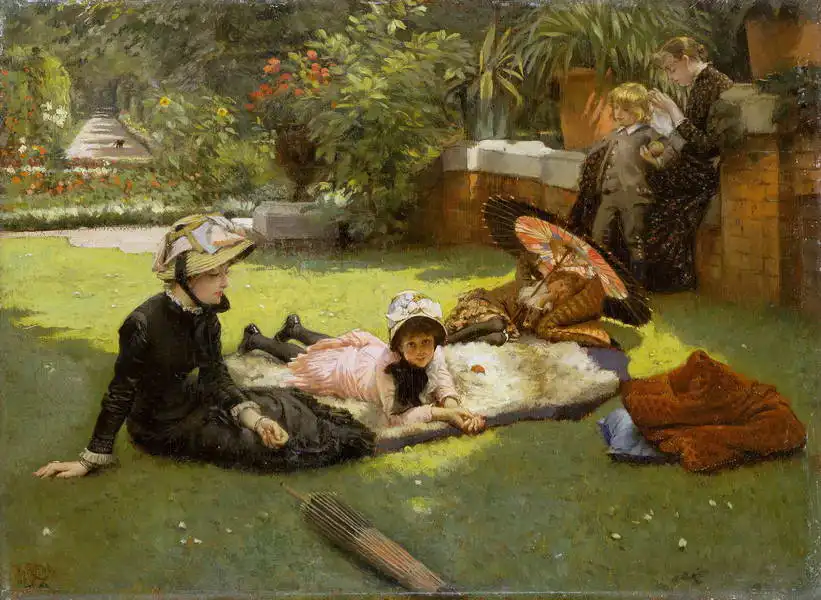
The painting depicts a group of people in an idyllic garden. Two women and two children are relaxing on the lawn, surrounded by rich vegetation. In the foreground, a woman dressed in black lies next to a girl in a pink dress; the woman is wearing a wide-brimmed hat. In the background is another woman and a boy; the woman is standing while the boy is watching something outside the painting. We see piles of clothes and an umbrella on the lawn.
This description was created by artificial intelligence, please be indulgent.
Prevailing color of this fine art print is vivid and its shape is landscape. This image is printed on demand - you can choose material, size and finishing.
French painter and illustrator
Jacques Joseph Tissot (1836-1902), later known as James Tissot, was born into a Catholic textile and a hat merchant family. Despite his father’s disapproval, Tissot wanted to become a painter. His mother supported him, however, and so at the age of 20 he went to Paris, where he enrolled at the Ecole des Beaux-Arts. He successfully completed his studies and soon exhibited five paintings of scenes from Goethe Faust. He also exhibited his paintings with a medieval theme, but a turning-point came in 1863. Tissot began capturing portraits of modern life in Paris -
Women in Paris - admirers of the circus. His paintings were positively received and immediately his fame equalled that of his peers, including
Claude Monet. After fighting in the Franco-Prussian war, he moved his work back to London, where he painted modern and elegantly clad women. After the death of his wife Kathleen Newton, he again moved to Paris, where he lived and worked until his death. He was offered membership to artistic groups of various styles, but he never accepted such offers and was faithful to
realism.



 776 273 496