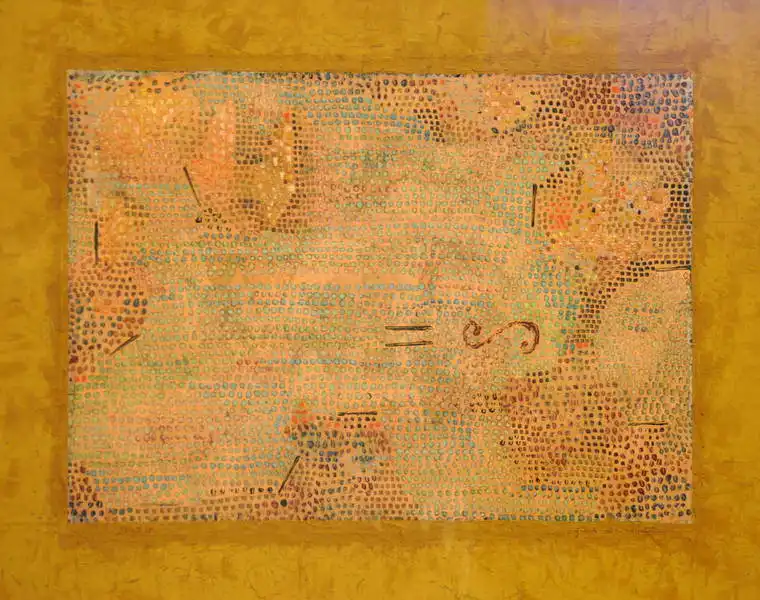
The painting depicts an abstract painting with densely spaced dots in various shades of orange, brown and ochre on a light background. The dots create a noise or texture effect reminiscent of pixels. Some geometric shapes and irregular lines are visible in the image, including chaotically spaced lines and parts of curves. The background is monochromatic, in warm ochres and yellows, which adds harmony and warmth to the image. The balance between the regularity of the dots and the spontaneity of the lines adds dynamism to the work.
This description was created by artificial intelligence, please be indulgent.
Klee painted picture Equals infinity in 1932. Prevailing color of this fine art print is orange and its shape is landscape. This image is printed on demand - you can choose material, size and finishing.
Paul Klee (1879-1940). From childhood, he was interested in both music and painting, but as is evident, finally decided on painting - his paintings are among prized artworks. In Munich, he met Kandinsky,Franz Marc, and other artists of the then avant-garde. He met also his future wife, pianist Lily Stumpf. His work is associated with a expressionism,cubism, and surrealism. He was one of the four Die Blaue Vier (with Kandinsky, Feininger and Jawlensky). He taught at Bauhaus and the Düsseldorf Academy until 1933, when the Nazis declared his paintings a figment of a sick soul and with labelled his whole creation as degenerate art. Klee was extremely hardworking and after his death, he left behind 8926 works in Switzerland. Klee’s paintings are fragile, with a sensitive use of color (his colour mixing ranks among the world’s best) and frequent references to poetry, music and dreams.
Trusted by our customers. Our customers have been satisfied with us for a long time. We appreciate it and thank you for your trust. You can find more reviews and details of our service ratings on Trustpilot.com.




 776 273 496
