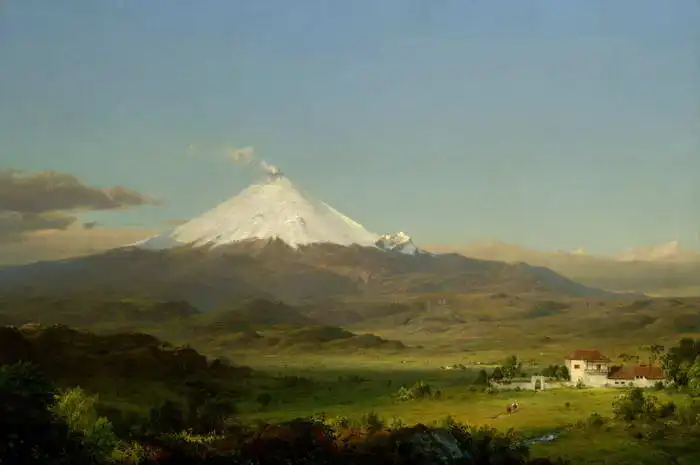
The painting depicts an idyllic landscape with a dominant snow-capped volcano in the background. A green plain with a few trees and grassy areas can be seen in the foreground. Near the center of the painting is a small settlement with white buildings and a red roof. Small figures of people and animals, probably cattle, are scattered in the fields below. The whole scene is bathed in a calm afternoon light, perhaps early or late afternoon, which gives the composition a peaceful atmosphere.
This description was created by artificial intelligence, please be indulgent.
Prevailing color of this fine art print is green and its shape is landscape. This image is printed on demand - you can choose material, size and finishing.
Frederic Edwin Church (1826-1900) was an American Romantic landscape painter born in Hartford, Connecticut. His father was a watchmaker and his younger brother founded the first paper mill in Lee, Massachusetts in Berkshires. A good background allowed him to pursue art from early childhood. At 18, he was the youngest worker in the National Academy of Design and a year later, he was awarded an academic title. He was the only student of Thomas Cole. Church’s style is evident in his paintings: rich representation of red, purple and orange, and the emphasis on imagination. Connections with rich customers enabled him to embark on two trips throughout South and North America. There, he could capture the beauty of the natural scenery in Ecuador during the rainy season or the splendor of Niagara Falls. Aurora borealis is a spectacular picture that leaves the viewer almost breathless. One of the four paintings from the series The Hearth of the Andes won him fame during the 1859 exhibition. He specialized also in faithful representations of Ecuadorian flora. His art is highly regarded not only in America.
Trusted by our customers. Our customers have been satisfied with us for a long time. We appreciate it and thank you for your trust. You can find more reviews and details of our service ratings on Trustpilot.com.



 776 273 496
