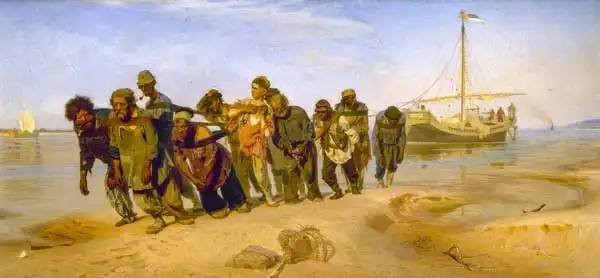
Date: 1873 Medium: oil on canvas Location: State Ruskon Museum, Petrohrad, Rusko Dimensions: 131 x 281
Testo tradotto automaticamente. Per favore, scusa eventuali errori!
Sono opera di un artista russo che è stato ispirato da uno dei suoi viaggi sul fiume Neva. Per la prima volta ha visto uomini che hanno tirato a monte navi di carico. Vale la pena notare i primi tre uomini. Il primo, potente e forte uomo ricorda l'eroe dimenticato delle vecchie poesie epiche russe. Il secondo è stato dipinto secondo un ex sacerdote, simboleggiando la saggezza e la ricchezza mentale. L'ultimo dei tre è il vecchio marinaio. L'espressione nei volti di tutti i soggetti coinvolti è piena di odio e sfida del loro lotto pesante. Dopo il completamento, il lavoro è stato assegnato alle mostre mondiali ed è diventato erroneamente anche una rappresentazione ideologica dell'oppressione del regime zarista odiato.
Repin painted picture Chiatte sul Volga in 1873. Prevailing color of this fine art print is varietà di colori and its shape is oblungo. Original size is 131 x 281. This art piece is located in State Ruskon Museum, Petrohrad, Rusko. This image is printed on demand - you can choose material, size and finishing.
Ilya Yefimovich Repin (1844-1930). Russian Realistic painter and sculptor. After the October revolution, he was wrongly presented as part of the infamous art movement called Socialist Realism. He graduated from the Academy in St. Petersburg, and lived in Italy and France. After his return to Russia, he worked in Moscow, from 1882 again in St. Petersburg, and from 1900 in the Finnish Kuokkala. He was influenced by Impressionism, which he encountered while studying in Paris. In the long-term, his style was closest to Rembrandt and he never became an Impressionist. He painted mostly scenes from the lives of ordinary and poor people, but also depicted former elite and intelligentsia (the Imperial family or Tolstoy). Among his best-known images is Barge Haulers on the Volga, in which he captured the conditions and the hard work of Russian serfs. He did not want to have anything to do with the revolution of 1917, and he did not paint revolutionary themes at all. He died in 1930 in Finland (he never wanted to go back to Russia). The Finnish city of Kuokkala was renamed Rjepino during the Soviet occupation of Finland.
Trusted by our customers. Our customers have been satisfied with us for a long time. We appreciate it and thank you for your trust. You can find more reviews and details of our service ratings on Trustpilot.com.



 776 273 496
