Craftfineart.com
Search
it
Oblíbené položky
Košík
È SPUNTATO IL NOSTRO SCONTO
ESTIVO, USA IL CODICE sale10

Il Piccolo Corvo con la spada del clan Minamoto

Katsushika Hokusai

×
Le nostre proposte di design:
semplicità
eleganza
moderno
vintage
classico


Il Piccolo Corvo con la spada del clan Minamoto

ID: #2708 | Arte asiatica | Animali

Date: 1823
Medium: coloured woodcut
Location: Pushkin Museum, Moscow, Russia

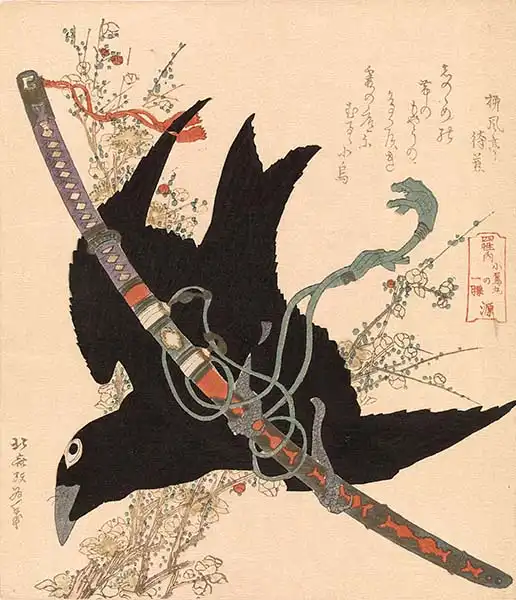
Il dipinto raffigura un grande uccello nero in volo, che appare energico e dinamico. L'uccello ha le ali e il becco spiegati e sembra essere catturato al momento di un grido o di un richiamo. Il suo corpo è stilizzato con contorni distintivi. L'uccello tiene nel becco una spada giapponese, la cui lama è ricoperta da un motivo intricato. Il dipinto è eseguito in stile tradizionale giapponese, con uno sfondo composto da fiori delicati e caratteri scritti che sembrano far parte di un antico manoscritto o di una poesia.
Creato dall'intelligenza artificiale, si prega di essere indulgenti.

Hokusai painted picture Il Piccolo Corvo con la spada del clan Minamoto in 1823. Prevailing color of this fine art print is bianco e nero and its shape is ritratto. This art piece is located in Pushkin Museum, Moscow, Russia. This image is printed on demand - you can choose material, size and finishing.

Katsushika Hokusai (1760-1849). The Japanese artist, painter of ukiyo-e (pictures of the fleeting world) and illustrator known today mainly for his series 36 Views of Mount Fuji. He was born in Edo (now Tokyo). His most used technique was woodcut, which he subsequently transferred using colours onto paper or silk. The technique originated in the 8th century in China, and in the 17th century, it began to spread to Japan. Using this technique, officials, the life of upper classes, cities, travels, etc. were captured. The most famous representative of this series is a painting titled the Great wave of Kanagawa. This xylograph was printed in approximately 5000 copies (therefore, there are different versions of the image). The image does not capture a tsunami, but rather okinami - literally translated, a folded wave on the open sea. Hokusai studied Japanese, Chinese, French and Dutch artwork and developed a distinctive style, which broke through the traditional and preconceived notions of what was then a Japanese painting. His work has had a global impact, and especially affected Impressionists.

Il Piccolo Corvo con la spada del clan Minamoto

Katsushika Hokusai

Motif size

Total size: 69 x 80 cm

Material


Finishing


Frame & passepartout

colour of passepartout
none

Selected finishing

Matte paper (print)
Share this settingShare this setting
Print. The image is printed on the top quality 10-ink HP Z9PS printer on HP matte 270 g / m2 paper. You can choose any size to an accuracy of 1 cm. A margin of 5 cm around the image is added to the size of the motif.

ZoomZoom

You can find a detailed description about our finishings here.

:
42 €

Shipping date: 2 days

Il Piccolo Corvo con la spada del clan Minamoto

ID: #2708 | Arte asiatica | Animali

Date: 1823
Medium: coloured woodcut
Location: Pushkin Museum, Moscow, Russia

Il dipinto raffigura un grande uccello nero in volo, che appare energico e dinamico. L'uccello ha le ali e il becco spiegati e sembra essere catturato al momento di un grido o di un richiamo. Il suo corpo è stilizzato con contorni distintivi. L'uccello tiene nel becco una spada giapponese, la cui lama è ricoperta da un motivo intricato. Il dipinto è eseguito in stile tradizionale giapponese, con uno sfondo composto da fiori delicati e caratteri scritti che sembrano far parte di un antico manoscritto o di una poesia.
Creato dall'intelligenza artificiale, si prega di essere indulgenti.

Hokusai painted picture Il Piccolo Corvo con la spada del clan Minamoto in 1823. Prevailing color of this fine art print is bianco e nero and its shape is ritratto. This art piece is located in Pushkin Museum, Moscow, Russia. This image is printed on demand - you can choose material, size and finishing.

Katsushika Hokusai (1760-1849). The Japanese artist, painter of ukiyo-e (pictures of the fleeting world) and illustrator known today mainly for his series 36 Views of Mount Fuji. He was born in Edo (now Tokyo). His most used technique was woodcut, which he subsequently transferred using colours onto paper or silk. The technique originated in the 8th century in China, and in the 17th century, it began to spread to Japan. Using this technique, officials, the life of upper classes, cities, travels, etc. were captured. The most famous representative of this series is a painting titled the Great wave of Kanagawa. This xylograph was printed in approximately 5000 copies (therefore, there are different versions of the image). The image does not capture a tsunami, but rather okinami - literally translated, a folded wave on the open sea. Hokusai studied Japanese, Chinese, French and Dutch artwork and developed a distinctive style, which broke through the traditional and preconceived notions of what was then a Japanese painting. His work has had a global impact, and especially affected Impressionists.


How do we make our pictures (detailed view)

Our reviews from Trustpilot.com

Trusted by our customers. Our customers have been satisfied with us for a long time. We appreciate it and thank you for your trust. You can find more reviews and details of our service ratings on Trustpilot.com.


You might like


69 x 80 cm
42 €