Craftfineart.com
Search
fr
Oblíbené položky
Košík
LES FEUILLES TOMBENT — PROMO D’AUTOMNE
UTILISEZ LE CODE sale10

Rinaldo et Armida

Nicolas Poussin

×
Nos propositions de conception:
simplicité
élégance
moderne
vintage
classique


Rinaldo et Armida

ID: #4508 | Baroque | Personnes

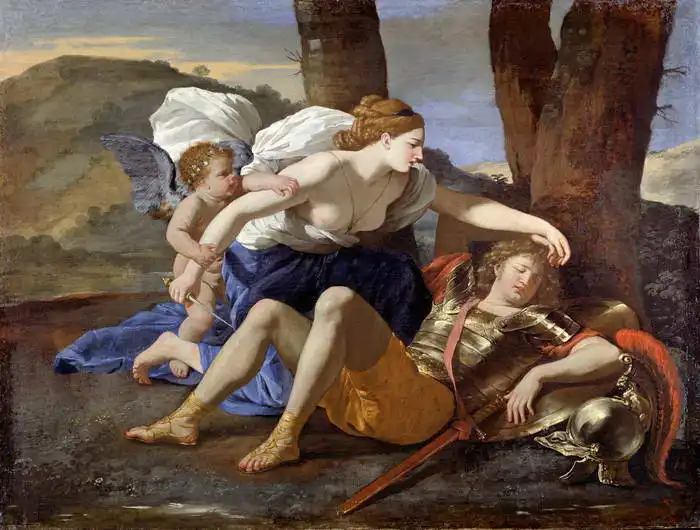
Le tableau représente trois personnages dans le style de la mythologie antique. Une femme vêtue d'une draperie bleue et ocre aide un homme en armure d'or qui est allongé sur le sol, comme s'il était mou ou endormi. Au-dessus d'eux, un enfant avec des ailes, un ange ou un cupidon, l'aide à soutenir l'arrière de son corps. À l'arrière-plan se trouvent des arbres et un paysage suggéré avec un ciel assombri. Dans l'ensemble, la scène est paisible et la composition s'inspire de l'esthétique mythologique classique.

Ce texte et les mots-clés ont été générés par une intelligence artificielle, merci de votre compréhension !


Prevailing color of this fine art print is sombre and its shape is paysage. This image is printed on demand - you can choose material, size and finishing.

Nicolas Poussin (1594-1665) was the leading representative of the French Baroque. He was born in Normandy. His sketches caught the attention of local painter Quentin Varin, who took Niclace as his apprentice. At 18, he fled to Paris, where he studied painting techniques with Flemish masters Ferdinand Elle and Georges Lallemand. Thanks to his friendship with influential people, he was able to go to Rome at age 30, where he created his major works with strongly religious motives. The most famous is probably Birth of Venus, or the heroic Triumph of David. His work is a great inspiration for many later prominent painters due to its purity, brightness and sense of order. He suffered declining health and in 1650, the tremor in his hand began to worsen, which was reflected in his later drawings. His difficulties persisted and in 1665 he died in Rome and was buried in the church of San Lorenzo in Lucina.

Rinaldo et Armida

Nicolas Poussin

Motif size

Total size: 80 x 61 cm

Material


Finishing


Frame & passepartout

colour of passepartout
none

Selected finishing

Matte paper (print)
Share this settingShare this setting
Print. The image is printed on the top quality 9-ink HP Z9PS printer on Fomei Cotton Smoooth g / m2 paper. You can choose any size to an accuracy of 1 cm. A margin of 5 cm around the image is added to the size of the motif.

ZoomZoom

You can find a detailed description about our finishings here.

:
39 €

Shipping date: 2 days

Rinaldo et Armida

ID: #4508 | Baroque | Personnes

Le tableau représente trois personnages dans le style de la mythologie antique. Une femme vêtue d'une draperie bleue et ocre aide un homme en armure d'or qui est allongé sur le sol, comme s'il était mou ou endormi. Au-dessus d'eux, un enfant avec des ailes, un ange ou un cupidon, l'aide à soutenir l'arrière de son corps. À l'arrière-plan se trouvent des arbres et un paysage suggéré avec un ciel assombri. Dans l'ensemble, la scène est paisible et la composition s'inspire de l'esthétique mythologique classique.

Ce texte et les mots-clés ont été générés par une intelligence artificielle, merci de votre compréhension !


Prevailing color of this fine art print is sombre and its shape is paysage. This image is printed on demand - you can choose material, size and finishing.

Nicolas Poussin (1594-1665) was the leading representative of the French Baroque. He was born in Normandy. His sketches caught the attention of local painter Quentin Varin, who took Niclace as his apprentice. At 18, he fled to Paris, where he studied painting techniques with Flemish masters Ferdinand Elle and Georges Lallemand. Thanks to his friendship with influential people, he was able to go to Rome at age 30, where he created his major works with strongly religious motives. The most famous is probably Birth of Venus, or the heroic Triumph of David. His work is a great inspiration for many later prominent painters due to its purity, brightness and sense of order. He suffered declining health and in 1650, the tremor in his hand began to worsen, which was reflected in his later drawings. His difficulties persisted and in 1665 he died in Rome and was buried in the church of San Lorenzo in Lucina.


How do we make our pictures (detailed view)

Our reviews from Trustpilot.com

Trusted by our customers. Our customers have been satisfied with us for a long time. We appreciate it and thank you for your trust. You can find more reviews and details of our service ratings on Trustpilot.com.


You might like


80 x 61 cm
39 €