Craftfineart.com
Search
fr
Oblíbené položky
Košík
NOTRE REMISE D'ÉTÉ A ÉCLATÉ,
UTILISEZ LE CODE sale10

Champ de coquelicots

Claude Monet

×
Nos propositions de conception:
simplicité
élégance
moderne
vintage
classique


Champ de coquelicots

ID: #3182 | Impressionnisme | Paysages

Date: 1881
Medium: oil on canvas
Location: Museum Boijmans Van Beuningen, Rotterdam, Nizozemí
Dimensions: 79 x 58

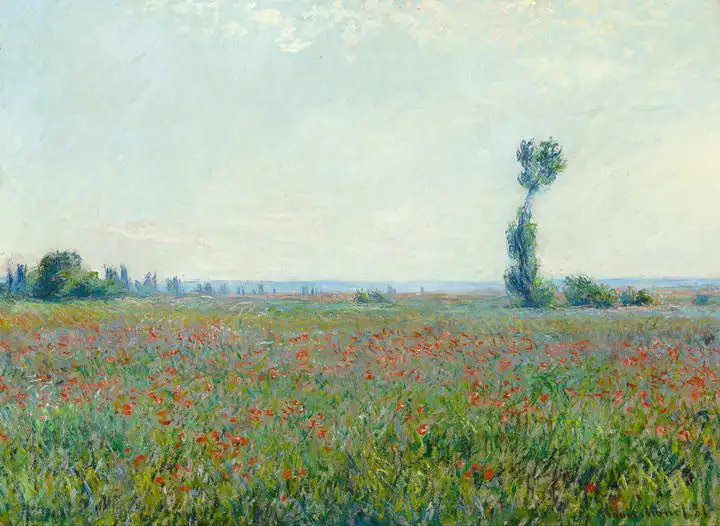
Le tableau représente un paysage idyllique avec une prairie fleurie pleine de coquelicots rouges. Le ciel est bleu clair avec des nuages blancs. Des bandes de terres agricoles et des arbres lointains sont visibles à l'horizon. Sur le côté droit de l'horizon, un arbre solitaire se distingue par sa hauteur et son épaisse couronne verte, donnant à la scène une impression de profondeur. Le style de la peinture suggère qu'il s'agit d'une œuvre impressionniste, avec des coups de pinceau doux et une lumière diffuse.
Créé par une intelligence artificielle, veuillez faire preuve d'indulgence.

Monet painted picture Champ de coquelicots in 1881. Prevailing color of this fine art print is vert and its shape is paysage. Original size is 79 x 58. This art piece is located in Museum Boijmans Van Beuningen, Rotterdam, Nizozemí. This image is printed on demand - you can choose material, size and finishing.

Claude Oscar Monet (1840-1926). A native Parisian, who thoroughly developed the idea of Impressionism. Monet almost scientifically studied the effect of light on different objects. He devoted himself to so called transitory states, which quickly led him to work with colour and light, his paintings acting on the viewer from the first impression. His use of open-air painting and objects which were special only because of light opened the way for the beginnings of modern painting. Monet’s Impression, Sunrise (1874) not only gave the name to the whole art movement, but secured Monet a place among the best painters of all times. At one time, he resided in London and created his famous study Houses of Parliament (Monet wondered, How could the English painters paint Parliament when it cannot be seen for the fog?). In the Giverny, which became his favourite retreat after the death of his wife, he painted motifs from his garden and the popular series Water Lilies - the world of the water was as poetic and mysterious as a primordial paradise.

Champ de coquelicots

Claude Monet

Motif size

Total size: 80 x 58 cm

Material


Finishing


Frame & passepartout

colour of passepartout
none

Selected finishing

Matte paper (print)
Share this settingShare this setting
Print. The image is printed on the top quality 10-ink HP Z9PS printer on HP matte 270 g / m2 paper. You can choose any size to an accuracy of 1 cm. A margin of 5 cm around the image is added to the size of the motif.

ZoomZoom

You can find a detailed description about our finishings here.

:
39 €

Shipping date: 2 days

Champ de coquelicots

ID: #3182 | Impressionnisme | Paysages

Date: 1881
Medium: oil on canvas
Location: Museum Boijmans Van Beuningen, Rotterdam, Nizozemí
Dimensions: 79 x 58

Le tableau représente un paysage idyllique avec une prairie fleurie pleine de coquelicots rouges. Le ciel est bleu clair avec des nuages blancs. Des bandes de terres agricoles et des arbres lointains sont visibles à l'horizon. Sur le côté droit de l'horizon, un arbre solitaire se distingue par sa hauteur et son épaisse couronne verte, donnant à la scène une impression de profondeur. Le style de la peinture suggère qu'il s'agit d'une œuvre impressionniste, avec des coups de pinceau doux et une lumière diffuse.
Créé par une intelligence artificielle, veuillez faire preuve d'indulgence.

Monet painted picture Champ de coquelicots in 1881. Prevailing color of this fine art print is vert and its shape is paysage. Original size is 79 x 58. This art piece is located in Museum Boijmans Van Beuningen, Rotterdam, Nizozemí. This image is printed on demand - you can choose material, size and finishing.

Claude Oscar Monet (1840-1926). A native Parisian, who thoroughly developed the idea of Impressionism. Monet almost scientifically studied the effect of light on different objects. He devoted himself to so called transitory states, which quickly led him to work with colour and light, his paintings acting on the viewer from the first impression. His use of open-air painting and objects which were special only because of light opened the way for the beginnings of modern painting. Monet’s Impression, Sunrise (1874) not only gave the name to the whole art movement, but secured Monet a place among the best painters of all times. At one time, he resided in London and created his famous study Houses of Parliament (Monet wondered, How could the English painters paint Parliament when it cannot be seen for the fog?). In the Giverny, which became his favourite retreat after the death of his wife, he painted motifs from his garden and the popular series Water Lilies - the world of the water was as poetic and mysterious as a primordial paradise.


How do we make our pictures (detailed view)

Our reviews from Trustpilot.com

Trusted by our customers. Our customers have been satisfied with us for a long time. We appreciate it and thank you for your trust. You can find more reviews and details of our service ratings on Trustpilot.com.


You might like


80 x 58 cm
39 €