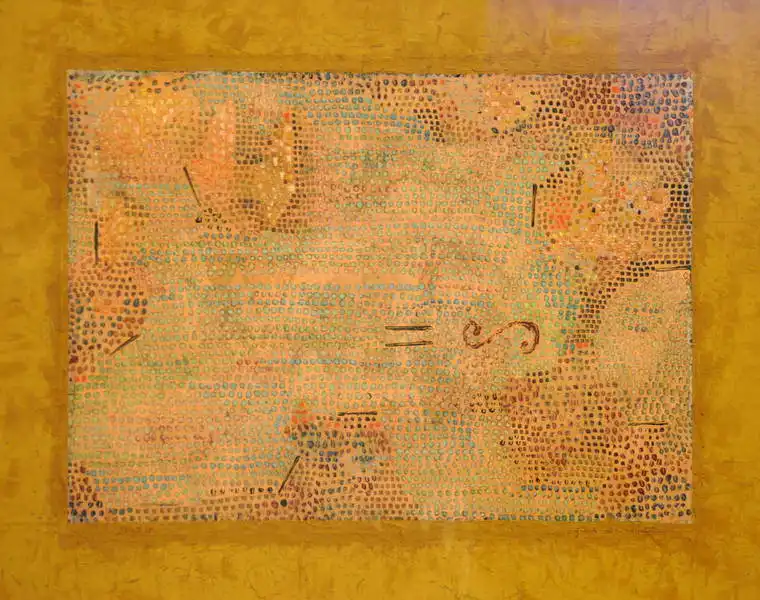
Le tableau représente une peinture abstraite avec des points densément espacés dans différentes nuances d'orange, de brun et d'ocre sur un fond clair. Les points créent un effet de bruit ou de texture rappelant les pixels. Certaines formes géométriques et lignes irrégulières sont visibles dans l'image, y compris des lignes chaotiquement espacées et des parties de courbes. L'arrière-plan est monochrome, avec des ocres et des jaunes chauds, ce qui ajoute de l'harmonie et de la chaleur à l'image. L'équilibre entre la régularité des points et la spontanéité des lignes ajoute du dynamisme à l'œuvre.
Ce texte et les mots-clés ont été générés par une intelligence artificielle, merci de votre compréhension !
Klee painted picture Égal à l'infini in 1932. Prevailing color of this fine art print is orange and its shape is paysage. This image is printed on demand - you can choose material, size and finishing.
Paul Klee (1879-1940). From childhood, he was interested in both music and painting, but as is evident, finally decided on painting - his paintings are among prized artworks. In Munich, he met Kandinsky,Franz Marc, and other artists of the then avant-garde. He met also his future wife, pianist Lily Stumpf. His work is associated with a expressionism,cubism, and surrealism. He was one of the four Die Blaue Vier (with Kandinsky, Feininger and Jawlensky). He taught at Bauhaus and the Düsseldorf Academy until 1933, when the Nazis declared his paintings a figment of a sick soul and with labelled his whole creation as degenerate art. Klee was extremely hardworking and after his death, he left behind 8926 works in Switzerland. Klee’s paintings are fragile, with a sensitive use of color (his colour mixing ranks among the world’s best) and frequent references to poetry, music and dreams.
Trusted by our customers. Our customers have been satisfied with us for a long time. We appreciate it and thank you for your trust. You can find more reviews and details of our service ratings on Trustpilot.com.



 776 273 496
