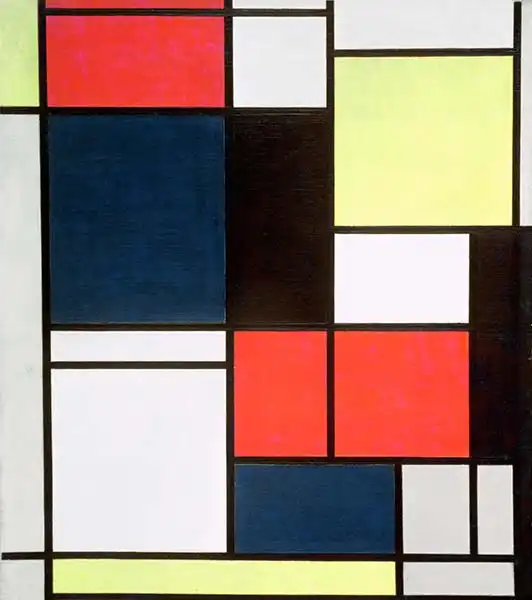
Este cuadro es una composición abstracta de cuadrados y rectángulos en colores primarios: rojo, azul y amarillo, junto con blanco y negro. El cuadro tiene un diseño sencillo y limpio en el que las líneas negras crean una cuadrícula que divide el lienzo en áreas geométricas más pequeñas. La composición es simétrica y cada color está distribuido uniformemente por el cuadro, logrando un equilibrio visual.
Este texto y las palabras clave fueron creados por una inteligencia artificial, ¡por favor sean indulgentes!
Mondrian painted picture Composición no. II en rojo, azul, negro y gris in 1925. Prevailing color of this fine art print is vívido and its shape is retrato. This image is printed on demand - you can choose material, size and finishing.
Piet Mondrian (1872-1944) Painter. Despite being from a family of drawing teachers, he was initially drawn to a priestly life. At last, his uncle brought him to painting as he had enrolled Mondrian at the Academy in Amsterdam. Mondrian experimented in his painting. His early works bear a clear inspiration from impressionism. At the 1911 exhibition in Amsterdam, he met with the newly beginning style of Cubism, of which he became very fond. Through continuous painting of the same object ( Tableau I), he tried to capture its true nature. For three years, he lived in Paris, but with the beginning of World War I, he returned to Holland. He did not remain long, and again returned to Paris, where he created very abstract images - Duinlandschap. His greatest fame, paradoxically, came in the USA, where he had to move under the threat of Nazism in 1938. It is said that he worked so hard that he had blisters on his hands from paint brushes. Through his geometricism he influenced many of his successors. Piet Mondrian died 1. 2. 1944 pneumonia.
Trusted by our customers. Our customers have been satisfied with us for a long time. We appreciate it and thank you for your trust. You can find more reviews and details of our service ratings on Trustpilot.com.



 776 273 496
