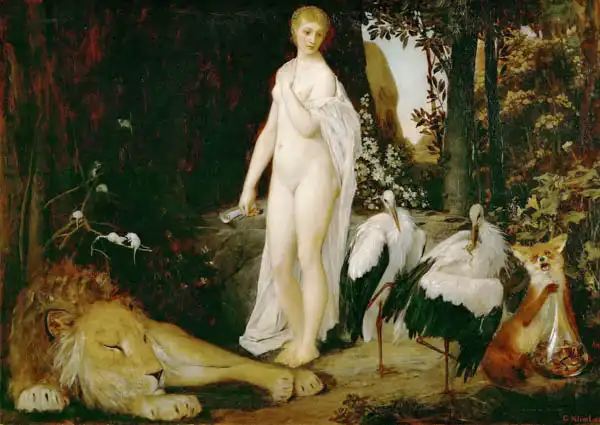
Fabel, en la traducción checa de Bajka, se llama la imagen del pintor de Art Nouveau, Gustav Klimt. Esta pintura fue pintada en 1883 para la portada del título de Gerlach & Schenk. La imagen está cubierta con muchos símbolos y atributos misteriosos. Podemos notar que una mujer tiene un pergamino de papel en su mano derecha, por el contrario, sostiene una tela blanca que le cubre la espalda. La mujer tiene rasgos de Europa occidental, diferentes de las caras austriacas clásicas que aparecen con mucha más frecuencia en las pinturas de Klimt. La alegoría de este trabajo se representa en el fondo. La mujer se encuentra afuera en la naturaleza, en el camino en el bosque. Está rodeado de vegetación y principalmente desierto. A la derecha de la mujer llena el lugar en la imagen del pájaro blanco y negro. Un par de animales se equilibran en una pierna. Además de los animales exóticos, el zorro está construido en las patas traseras con la boca abierta en la mendicidad. Una mezcla interesante de animales lleva al espectador a la pregunta de qué está sucediendo exactamente. A la derecha de la encantadora mujer duerme en el suelo un gran león. Por encima del león se representan tres pequeños ratones blancos que se equilibran en la rama, que crean un equilibrio entre un gran león y un ratón pequeño. Cuatro tipos diferentes de animales representados en el lienzo agregan un elemento interesante al trabajo y obliga al espectador a pensar en cuál es el simbolismo de cada uno de ellos en relación con la mujer. Se logra un tema utópico a través de una obra de arte porque todas las criaturas vienen en su conjunto y viven en armonía. Tal vez es un mensaje que un artista brillante intenta retratar en una hermosa obra de arte.
Klimt painted picture Fábula in 1883. Prevailing color of this fine art print is marrón and its shape is paisaje. Original size is 83,5x116. This art piece is located in Wien Museum Karlsplatz, Vienna, Austria. This image is printed on demand - you can choose material, size and finishing.
Gustav Klimt (1862-1918). As a painter, Klimt represents the best period of Vienna – a time when the works of Sigmund Freud or Mahler were developing, and Vienna was at the very least the Central European centre of culture and education. Klimt’s work combines symbolism and Byzantine features that create the undertone of his Art Nouveau style. Klimt’s images have a special, even anxious, atmosphere that often shows the Freudian idea of erotica in any human movement and action. Klimt paints two-dimensionally, with intense colour while at the same time very gently and with refined dignity. Among Klimt’s famous works are the Water Snakes - two women with stylized, interwoven bodies that evoke the surreal world of fantasy and sensuality. Another masterpiece is Danae, a work inspired by Greek mythology, depicting a girl seized by Zeus, who was turned into a golden rain (Danae later gave birth to Perseus). His paintings often aroused passions and public protests, not only for their content but also for the innovative painting methods - eg. The Girlfriends, an image of two women at a romantic meeting.
Trusted by our customers. Our customers have been satisfied with us for a long time. We appreciate it and thank you for your trust. You can find more reviews and details of our service ratings on Trustpilot.com.




 776 273 496
