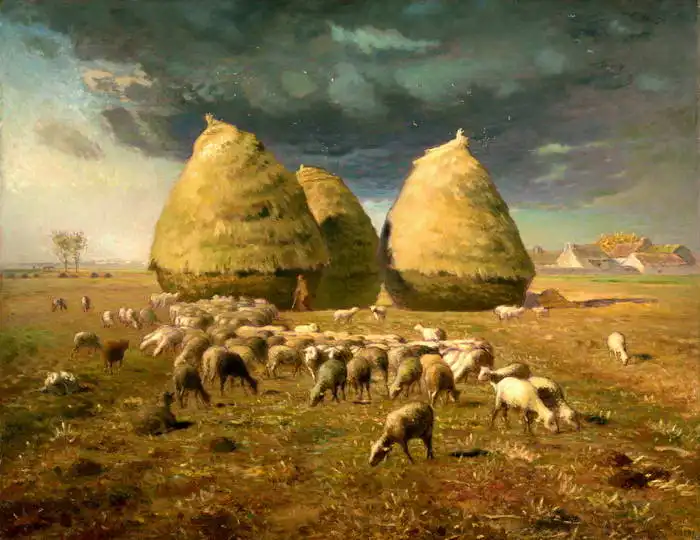
Das Gemälde zeigt eine idyllische ländliche Szene mit großen Heuschobern und einer Schafherde, die auf einem Feld weidet. Der Himmel ist dramatischer mit dunklen Wolken und Licht, das durch die Wolken scheint. Die Landschaft ist weit und wirkt warm und friedlich. Im Hintergrund sind Bäume und schwach angedeutete Umrisse von Gebäuden zu sehen, was darauf hindeutet, dass es sich nicht um eine karge Landschaft, sondern um einen Ort in der Nähe menschlicher Siedlungen handelt.
Dieser Text und die Schlüsselwörter wurden von einer künstlichen Intelligenz erstellt, bitte haben Sie Verständnis!
Prevailing color of this fine art print is gelb and its shape is landschaft. This image is printed on demand - you can choose material, size and finishing.
Jean-Francois Millet (1814-1875). At the outset of his career, he refused the stereotyped concept of painting and became a free portrait painter. He influenced Impressionists through his selection of topics: he painted simple people, poor farmers and the humility of hardworking people. He loved the countryside where he lived, devoted a lot of energy for rural people. Millet’s paintings are characterized by an interesting, gold and melancholy light that gives his landscapes a religious character. The Angelus - church bells in the distance strike as two people say a prayer of thanks for the harvest (ironically, the Louvre auctioned this painting for an astronomical sum). Gleaners. The monumentality of characters achieved through simplification of the environment (which was later used by Seurat) is clamped from above by the horizon. The image probably expresses the oppression of peasants (especially women without voting rights) after 1848.
Trusted by our customers. Our customers have been satisfied with us for a long time. We appreciate it and thank you for your trust. You can find more reviews and details of our service ratings on Trustpilot.com.




 776 273 496
