Craftfineart.com
Search
de
Oblíbené položky
Košík
UNSER SOMMERRABATT IST AUFGETAUCHT,
VERWENDEN SIE DEN CODE sale10
×
Unsere Gestaltungsvorschläge:
einfachheit
eleganz
modern
vintage
klassisch


Kniend

ID: #1891 | TOP 100 | Realismus | Menschen

Date: 1857
Medium: oil on canvas
Location: Musee d'Orsay, Paris, France
Dimensions: 55.5 x 66

Automatisch übersetzter Text. Bitte entschuldigen Sie alle Fehler!

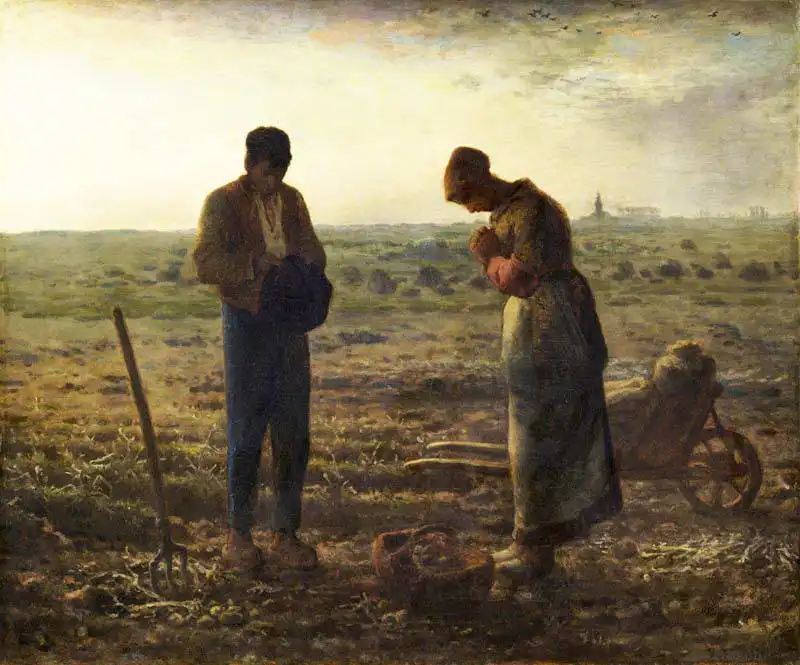
Die Linien der Kartoffeln werden durch warmes Abendlicht beleuchtet, und der Mann und die Frau unterbrachen die Arbeit, um das Knien zu beten (was wahrscheinlich die Glocken aus der Kirche im Hintergrund klingelt). Das Bild ist eine Hommage an harte menschliche Arbeit, Frömmigkeit, Demut und Respekt vor der Natur. Das Bild bestritt nicht, dass Millet selbst von einer bäuerlichen Familie und einer ähnlichen Szene sehr gut stammte.

Millet painted picture Kniend in 1857. Prevailing color of this fine art print is dunkel and its shape is landschaft. Original size is 55.5 x 66. This art piece is located in Musee d'Orsay, Paris, France. This image is printed on demand - you can choose material, size and finishing.

Jean-Francois Millet (1814-1875). At the outset of his career, he refused the stereotyped concept of painting and became a free portrait painter. He influenced Impressionists through his selection of topics: he painted simple people, poor farmers and the humility of hardworking people. He loved the countryside where he lived, devoted a lot of energy for rural people. Millet’s paintings are characterized by an interesting, gold and melancholy light that gives his landscapes a religious character. The Angelus - church bells in the distance strike as two people say a prayer of thanks for the harvest (ironically, the Louvre auctioned this painting for an astronomical sum). Gleaners. The monumentality of characters achieved through simplification of the environment (which was later used by Seurat) is clamped from above by the horizon. The image probably expresses the oppression of peasants (especially women without voting rights) after 1848.

Motif size

Total size: 80 x 67 cm

Material


Finishing


Frame & passepartout

colour of passepartout
none

Selected finishing

Matte paper (print)
Share this settingShare this setting
Print. The image is printed on the top quality 10-ink HP Z9PS printer on HP matte 270 g / m2 paper. You can choose any size to an accuracy of 1 cm. A margin of 5 cm around the image is added to the size of the motif.

ZoomZoom

You can find a detailed description about our finishings here.

:
41 €

Shipping date: 2 days

Kniend

ID: #1891 | TOP 100 | Realismus | Menschen

Date: 1857
Medium: oil on canvas
Location: Musee d'Orsay, Paris, France
Dimensions: 55.5 x 66

Automatisch übersetzter Text. Bitte entschuldigen Sie alle Fehler!

Die Linien der Kartoffeln werden durch warmes Abendlicht beleuchtet, und der Mann und die Frau unterbrachen die Arbeit, um das Knien zu beten (was wahrscheinlich die Glocken aus der Kirche im Hintergrund klingelt). Das Bild ist eine Hommage an harte menschliche Arbeit, Frömmigkeit, Demut und Respekt vor der Natur. Das Bild bestritt nicht, dass Millet selbst von einer bäuerlichen Familie und einer ähnlichen Szene sehr gut stammte.

Millet painted picture Kniend in 1857. Prevailing color of this fine art print is dunkel and its shape is landschaft. Original size is 55.5 x 66. This art piece is located in Musee d'Orsay, Paris, France. This image is printed on demand - you can choose material, size and finishing.

Jean-Francois Millet (1814-1875). At the outset of his career, he refused the stereotyped concept of painting and became a free portrait painter. He influenced Impressionists through his selection of topics: he painted simple people, poor farmers and the humility of hardworking people. He loved the countryside where he lived, devoted a lot of energy for rural people. Millet’s paintings are characterized by an interesting, gold and melancholy light that gives his landscapes a religious character. The Angelus - church bells in the distance strike as two people say a prayer of thanks for the harvest (ironically, the Louvre auctioned this painting for an astronomical sum). Gleaners. The monumentality of characters achieved through simplification of the environment (which was later used by Seurat) is clamped from above by the horizon. The image probably expresses the oppression of peasants (especially women without voting rights) after 1848.


How do we make our pictures (detailed view)

Our reviews from Trustpilot.com

Trusted by our customers. Our customers have been satisfied with us for a long time. We appreciate it and thank you for your trust. You can find more reviews and details of our service ratings on Trustpilot.com.


You might like


80 x 67 cm
41 €