Craftfineart.com
Search
de
Oblíbené položky
Košík
UNSER SOMMERRABATT IST AUFGETAUCHT,
VERWENDEN SIE DEN CODE sale10
×
Unsere Gestaltungsvorschläge:
einfachheit
eleganz
modern
vintage
klassisch


Hund

ID: #3565 | TOP 100 | Romantismus | Tiere

Date: 1819-1823
Medium: oil on canvas
Location: Museo del Prado, Madrid
Dimensions: 79.3 x 131.5

Automatisch übersetzter Text. Bitte entschuldigen Sie alle Fehler!


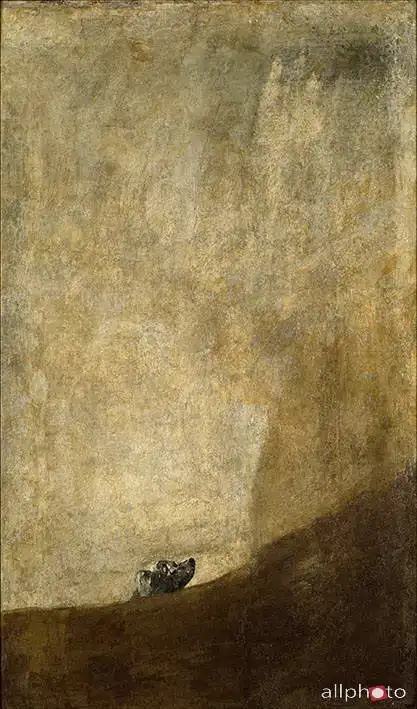
Auf dem Bild können wir den Kopf eines kleinen schwarzen Hundes sehen, der nach oben schaut. Der Rest seines Körpers ist hinter der unbestimmten braunen Masse am Boden des Bildes versteckt. Der Hund ist eines der 14 Gemälde, die Goya zwischen 1819 und 1823 direkt an den Wänden seines Hauses gemalt hat. Diese Gemälde wurden noch nie für öffentliche Ausstellungen gedacht und wurden bis zu seinem Tod den Augen gewöhnlicher Menschen noch nie ausgesetzt.

Goya painted picture Hund in 1819-1823. Prevailing color of this fine art print is braun and its shape is porträt. Original size is 79.3 x 131.5. This art piece is located in Museo del Prado, Madrid. This image is printed on demand - you can choose material, size and finishing.

Francisco de Goya (1746-1828). Born in Spain, the son of a goldsmith. His work is characterized by loose brush strokes, an unprecedented release from the obligation to draw exactly according to reality. His works are among the precursors of many future artistic directions (Realism, Romanticism, Impressionism, Expressionism, and Surrealism). He became the court painter to Charles IV and a member of the Academy. Among Goya’s most famous works are the cycle Disasters of War (eg. The Third of May 1808, a picture painted during the Spanish revolution against France, in which Goya utilises his typical brush strokes and plays with light, clearly showing on which side he stands) and portraits Clothed Maja and Naked Maja. The nude was, for the time, sensual, natural, and without unnecessary decorations (flowers, nature, silk). It is no coincidence that, for this painting, Goya was prosecuted by the Inquisition.

Motif size

Total size: 47 x 80 cm

Material


Finishing


Frame & passepartout

colour of passepartout
none

Selected finishing

Matte paper (print)
Share this settingShare this setting
Print. The image is printed on the top quality 10-ink HP Z9PS printer on HP matte 270 g / m2 paper. You can choose any size to an accuracy of 1 cm. A margin of 5 cm around the image is added to the size of the motif.

ZoomZoom

You can find a detailed description about our finishings here.

:
36 €

Shipping date: 2 days

Hund

ID: #3565 | TOP 100 | Romantismus | Tiere

Date: 1819-1823
Medium: oil on canvas
Location: Museo del Prado, Madrid
Dimensions: 79.3 x 131.5

Automatisch übersetzter Text. Bitte entschuldigen Sie alle Fehler!


Auf dem Bild können wir den Kopf eines kleinen schwarzen Hundes sehen, der nach oben schaut. Der Rest seines Körpers ist hinter der unbestimmten braunen Masse am Boden des Bildes versteckt. Der Hund ist eines der 14 Gemälde, die Goya zwischen 1819 und 1823 direkt an den Wänden seines Hauses gemalt hat. Diese Gemälde wurden noch nie für öffentliche Ausstellungen gedacht und wurden bis zu seinem Tod den Augen gewöhnlicher Menschen noch nie ausgesetzt.

Goya painted picture Hund in 1819-1823. Prevailing color of this fine art print is braun and its shape is porträt. Original size is 79.3 x 131.5. This art piece is located in Museo del Prado, Madrid. This image is printed on demand - you can choose material, size and finishing.

Francisco de Goya (1746-1828). Born in Spain, the son of a goldsmith. His work is characterized by loose brush strokes, an unprecedented release from the obligation to draw exactly according to reality. His works are among the precursors of many future artistic directions (Realism, Romanticism, Impressionism, Expressionism, and Surrealism). He became the court painter to Charles IV and a member of the Academy. Among Goya’s most famous works are the cycle Disasters of War (eg. The Third of May 1808, a picture painted during the Spanish revolution against France, in which Goya utilises his typical brush strokes and plays with light, clearly showing on which side he stands) and portraits Clothed Maja and Naked Maja. The nude was, for the time, sensual, natural, and without unnecessary decorations (flowers, nature, silk). It is no coincidence that, for this painting, Goya was prosecuted by the Inquisition.


How do we make our pictures (detailed view)

Our reviews from Trustpilot.com

Trusted by our customers. Our customers have been satisfied with us for a long time. We appreciate it and thank you for your trust. You can find more reviews and details of our service ratings on Trustpilot.com.


You might like


47 x 80 cm
36 €