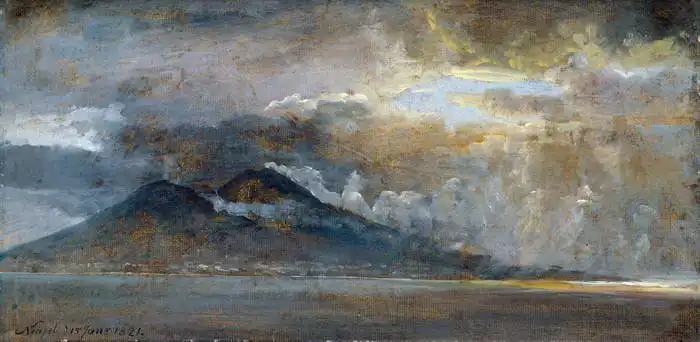
Das Bild zeigt eine dramatische Landschaft mit einem dominanten Berg, bei dem es sich wahrscheinlich um einen Vulkan handelt. Der Himmel ist in schwere Wolken gehüllt, und in der Mitte ist die Durchsichtigkeit der Sonne zu erkennen, die geheimnisvolles Licht und Schatten auf die Szene wirft. Der unterste Teil des Bildes ist dunkler und lässt auf Wasser oder eine Ebene schließen. Technisch gesehen handelt es sich um ein Landschaftsgemälde, bei dem dunkle und helle Schattierungen verwendet werden, um eine visuell beeindruckende Atmosphäre zu schaffen.
Dieser Text und die Schlüsselwörter wurden von einer künstlichen Intelligenz erstellt, bitte haben Sie Verständnis!
Prevailing color of this fine art print is lebendig and its shape is lang. This image is printed on demand - you can choose material, size and finishing.
Johan Christian Claussen Dahl (1788-1857) was the first Norwegian Romantic painter. He was born into a family of simple fishermen from Bergen. At first, he studied theology, but his teacher soon revealed Dahl’s talent. Therefore, he moved under the supervision of the most respectable Bergen master painter, Johann Georg Müller. He then completed his studies at the University of Copenhagen. There, he discovered his passion for landscape painting. It was, however, considered the lowest level of art in academic circles, which troubled Dahl as he wanted to capture the beauty and wildness of Norwegian nature ( Hellefossen at Hokksund) He improved his technique, for which he was rewarded in 1815 when the Danish Prince Christian Frederik himself commissioned him and bought 13 paintings for his royal collection. This brought Dahl not only recognition and fame, but also a great favour with the prince. The prince was the one who invited him to Italy in 1820, where Dahl spent 10 months and developed his landscape paintings to perfection. Like John Constable, he felt that the sky on canvas played an important role, which we see in the images Studies of Clouds, Clouds, or Rays of Sun in the Clouds. When he returned to Norway in the 1850s, he was officially welcomed. He participated in the establishment of the Norwegian National Gallery. His personal life, however, was sad. His wife died in childbirth, and two of his four children died of scarlet fever. He also prematurely died to this insidious disease in 1857. In 1934, his body was transferred to the cemetery at St. James Bergen.
Trusted by our customers. Our customers have been satisfied with us for a long time. We appreciate it and thank you for your trust. You can find more reviews and details of our service ratings on Trustpilot.com.




 776 273 496
